1. Low Precision Is Becoming the Default
Scaling laws continue to hold: model sizes have grown from tens of billions to hundreds of billions to trillions of parameters, and the compute and memory costs for training and inference have surged accordingly. Yet GPU memory and compute capacity cannot keep pace with the rate of model growth. Using low precision to store parameters or perform computation has become the industry’s inevitable response. From BF16 at 2 bytes to FP8 at 1 byte to FP4 at 0.5 byte, each step down nearly halves both memory footprint and compute cost.
The impact is tangible. DeepSeek-V3’s 671B parameters require over 1.3TB of memory in BF16, necessitating at least two-node deployment; switching to FP8 compresses this to roughly 685GB, fitting on a single 8×H200 machine [1]. GPT-OSS’s 120B parameters, with MXFP4-quantized MoE weights, fit entirely on a single 80GB GPU [2]. And DeepSeek-V4-Pro, at 1.6T parameters with MoE Experts stored in FP4 and other modules in FP8, can run inference on a single 8×B200 node [3].
These are not just inference-time compression tricks. DeepSeek-V3’s FP8 runs throughout the entire training process, with loss closely tracking the BF16 baseline [1]. DeepSeek-V4 embeds FP4 into the training pipeline itself via Quantization-Aware Training, rather than applying quantization post hoc [3]. Low precision is evolving from an inference optimization into part of the training paradigm.
How do we control the quality loss? The following covers three dimensions: numerical formats, scaling, and precision loss mitigation.
2. Numerical Formats and Representational Capacity
2.1 What Each Format Can Represent
A floating-point number consists of three components: sign bit (S), exponent bits (E), and mantissa bits (M). The exponent determines how large or small a number can be (dynamic range), while the mantissa determines the spacing between adjacent representable values (precision resolution).
| Format | Bits | S+E+M | Representable Values | Max Value | Per-Parameter Cost |
|---|---|---|---|---|---|
| FP32 | 32 | 1+8+23 | ~4.3 billion | 3.4×10³⁸ | 4 bytes |
| BF16 | 16 | 1+8+7 | 65,536 | 3.4×10³⁸ | 2 bytes |
| FP16 | 16 | 1+5+10 | 65,536 | 65,504 | 2 bytes |
| FP8 E4M3 | 8 | 1+4+3 | 256 | 448 | 1 byte |
| FP8 E5M2 | 8 | 1+5+2 | 256 | 57,344 | 1 byte |
| FP4 E2M1 | 4 | 1+2+1 | 16 | 6 | 0.5 byte |
Early deep learning used FP32 — 4 bytes per parameter, more than enough precision but enormous compute and storage overhead. Mixed Precision Training, proposed in 2018 [4][5], uses FP16 for forward and backward passes to achieve a 2× throughput boost, while maintaining FP32 master weights for parameter updates, balancing speed and accuracy. This quickly became standard practice.
However, FP16 revealed clear limitations for large model training. With only 5 exponent bits, FP16’s dynamic range caps at 65,504. As models scale up, gradients frequently produce extreme values that exceed this range — overflow triggers loss spikes, underflow zeros out gradients.
BF16 was designed precisely for this: it retains the same 8-bit exponent as FP32 (dynamic range up to 3.4×10³⁸), at the cost of reducing the mantissa from 23 to 7 bits. For training, dynamic range matters far more than mantissa precision — gradients that neither overflow nor vanish allow training to proceed stably. BF16 thus rapidly replaced FP16 as the default precision for large model training.
FP8 compresses further to 8 bits. Taking E4M3 as an example, it has only 256 representable values spread across [-448, 448].
Model weights typically cluster around ±0.01 — without scaling, only a handful of FP8 values fall in this narrow range, and many distinct weights get rounded to the same value. FP8 must be paired with scaling, as we’ll detail below.
FP4 is even more extreme: only 16 values total, with the positive representable values being {0, 0.5, 1, 1.5, 2, 3, 4, 6}. With such limited representational capacity, multi-level scaling and more sophisticated quantization strategies are essential.
It is worth noting that FP8 has two sub-formats with different roles: E4M3 (4 exponent + 3 mantissa bits) offers higher precision and is typically used for weight and activation storage in the forward pass; E5M2 (5 exponent + 2 mantissa bits) provides a wider dynamic range (max 57,344), better suited for gradients whose value range fluctuates more than weights [6].
Notably, DeepSeek-V3 chose to use E4M3 exclusively, relying on fine-grained scaling to compensate for the reduced dynamic range — a fairly aggressive choice [1].
2.2 FP vs INT: Two Quantization Paths
Two technical routes exist in quantization: floating-point (FP) and integer (INT). Their core difference lies in how values are distributed:
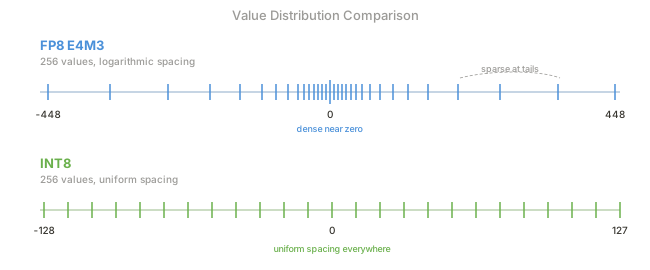
Neural network weights and activations typically follow a bell-shaped distribution — most values cluster near zero, with a few outliers at the tails. FP’s logarithmic spacing naturally provides higher resolution near zero, matching this distribution. INT distributes representational capacity uniformly across the entire range, wasting capacity in sparse tail regions while offering less resolution near zero than FP formats.
So what is INT’s value? Hardware cost. An FP8 FMA (fused multiply-add) unit occupies 40-50% more die area than INT8, with higher power consumption. On edge devices, mobile, and dedicated inference chips, INT remains the mainstream choice. Additionally, INT toolchains are more mature (GPTQ [7], AWQ [8], bitsandbytes [9]), and virtually all GPUs support INT8 computation.
In short: choose FP for precision-sensitive scenarios, INT when hardware-constrained.
3. Scaling: Compensating for Limited Dynamic Range
3.1 Why Scaling Is Needed
Low-precision formats have limited representable values. To make these limited values faithfully reproduce the high-precision value distribution, scaling maps data into the format’s effective representation range. Taking FP8 E4M3 as an example:
BF16: range [-3.4×10³⁸, 3.4×10³⁸], 8 exponent + 7 mantissa bits, 65536 representable values
FP8 E4M3: range [-448, 448], 4 exponent + 3 mantissa bits, 256 representable values
Direct truncation: mantissa 7→3 bits loses precision, exponent 8→4 bits may cause overflow or underflow.
Scaling maps the original value distribution into the low-precision format’s effective representation space, making full use of its limited capacity. The implementation is straightforward: compute the maximum absolute value amax of a data group, then scale = FP8_MAX / amax, multiply all values by scale before converting to FP8; dequantization simply divides by scale. This way, FP8’s limited 256 representable values concentrate on the actual data range, maximizing quantization precision.
3.2 Scaling Granularities
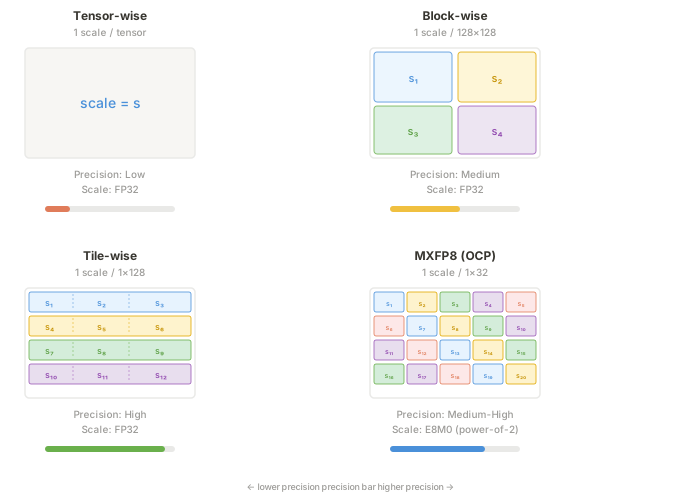
How much data should a single scale factor cover? Larger coverage means outliers have more destructive impact on overall precision; finer coverage yields higher precision but greater overhead. The industry has evolved several approaches [10]:
| Method | Granularity | Scale Format | Precision | Efficiency | Hardware |
|---|---|---|---|---|---|
| Tensor-wise | 1 scale per entire matrix | FP32 | Low | High (single FP32 op) | Hopper+ |
| Block-wise (128×128) | 1 scale per sub-block | FP32 | Medium | Medium (per-block FP32 ops) | Hopper+ |
| Tile-wise (1×128) | 1 scale per 128 elements | FP32 | High | Lower (per-tile FP32 ops) | Hopper+ |
| MXFP8 (OCP) | 1 scale per 32 elements | E8M0 | Medium-High | High (bit-shift, native on Blackwell) | Hopper+ |
Tensor-wise was the earliest approach — simply find the maximum absolute value of the entire matrix as the scale. The problem is extreme vulnerability to outliers: a single anomalously large value (e.g., everything is at 0.01 scale but one value is 10) dominates the scale for the entire matrix, drastically reducing quantization resolution for the remaining 99.99% of normal values. This approach is now essentially obsolete.
Block-wise partitions the matrix into 128×128 sub-blocks, each with an independent scale. Outlier impact is confined to its own sub-block, preventing contamination of the entire matrix. Scale is stored in FP32 — for a block of 128×128 = 16,384 elements, the overhead is merely 4 bytes / 16384 ≈ 0.02%.
Tile-wise goes finer still, computing one scale per 128 channels along the token dimension. Activation outliers tend to concentrate in specific channels (some channels’ average magnitude can be 10-100× that of others), and per-token fine-grained scaling adapts precisely to this pattern.
MXFP8 is the Microscaling standard proposed by OCP (Open Compute Project) [11]. Unlike the three “custom scaling” approaches above, MXFP8 builds scaling directly into the format specification: every 32 elements share one E8M0 scale factor (8-bit pure exponent, no mantissa, can only represent powers of 2).
In terms of granularity, MXFP8 is much finer than block-wise (16,384 elements/group), but its scale is restricted to power-of-2, yielding less precision than FP32 scales. The effective per-parameter cost is 8.25 bits (8 + 8/32). Hopper GPUs can support it via software emulation; Blackwell provides native hardware acceleration. The MXFP4 discussed in Section 3.3 belongs to the same MX family.
On efficiency, the first three approaches store scales in FP32, requiring FP32 floating-point multiplication for dequantization — overhead that grows as scale granularity gets finer. Tile-wise, with one FP32 dequantization per 128 elements, incurs the most overhead. MXFP8, despite having the finest granularity (32 elements/group), uses E8M0 power-of-2 scales where dequantization requires only bit-shift operations — far more efficient than FP32 multiplication. On Blackwell, MXFP8 scale application is handled natively by hardware without additional CUDA Core involvement, making its throughput advantage even more pronounced.
DeepSeek-V3’s approach: block-wise 128×128 for weights and tile-wise 1×128 for activations, with scales stored in FP32. DeepSeek-V3 was trained on H800 (Hopper architecture), and MXFP8’s native hardware acceleration requires Blackwell — on Hopper it can only run via software emulation with limited throughput gains. FP32 scales also offer better precision than E8M0’s power-of-2 constraint. The result: FP8 training loss within 0.25% of the BF16 baseline [1].
3.3 FP4: Format and Deployment Constraints
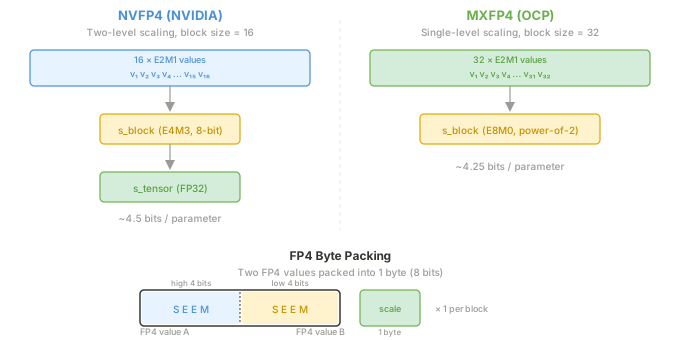
FP4 has only 16 values, requiring even finer-grained scaling strategies. Two mainstream approaches currently exist: NVIDIA’s proprietary NVFP4 [12] and the OCP open standard MXFP4:
| Property | NVFP4 | MXFP4 |
|---|---|---|
| Block size | 16 | 32 |
| Scale structure | Two-level (E4M3 + FP32) | Single-level (E8M0) |
| Effective per-parameter cost | ~4.5 bits | ~4.25 bits |
| Precision | Higher | Slightly lower |
| B200 throughput | Baseline | Slightly higher (E8M0 scale is simpler in hardware) |
| Ecosystem | NVIDIA proprietary | AMD/Intel/Meta/… multi-vendor |
NVFP4 uses smaller blocks (16 vs 32) and two-level scaling for better precision — in GPT-OSS fine-tuning experiments, NVFP4’s validation loss was about 2-3% lower than MXFP4 [13]. However, MXFP4’s E8M0 power-of-2 scale only requires bit-shift for dequantization, making it simpler in hardware with slightly better throughput; it also enjoys broader hardware support as an OCP open standard. In practice, the choice depends on precision vs ecosystem priorities. Note the “4.25 bits” figure: FP4 is nominally 4-bit, but with scale storage overhead, each parameter effectively costs 4.25-4.5 bits.
Two practical constraints affect FP4 deployment. First, 4-bit is not byte-aligned: two FP4 values must be packed into a single byte with scales tightly arranged, and reading a single FP4 value requires bit shifting and masking with special scale alignment handling — all adding kernel implementation complexity. Second, native FP4 Tensor Core support is currently limited to NVIDIA’s Blackwell architecture (B100/B200); on Hopper and earlier GPUs, FP4 can only run via software emulation without real throughput gains — the primary reason FP4 has not yet seen widespread adoption like FP8.
4. Reducing Precision Loss
Low precision is not a free lunch. Naively switching a model from BF16 to FP8 or FP4 often leads to training loss divergence and inference quality degradation. Precision loss stems from three main sources:
- Accumulation error: Individual multiply errors are tiny, but accumulating thousands in a matmul amplifies them → High-precision accumulation
- Rounding bias: Too few representable values cause deterministic rounding to introduce systematic bias → Stochastic Rounding
- Inter-module differences: Different modules tolerate different precision levels; uniform low precision is both wasteful and harmful → Module-level mixed precision
- Quantization-induced degradation: QAT lets the model adapt to quantization during training
4.1 High-Precision Accumulation
Matrix multiplication is the most fundamental compute unit in deep learning. A single Linear layer’s matmul may involve thousands of multiply-accumulate operations. The rounding error from a single FP8 multiplication is small, but after thousands of accumulations, the error grows to non-negligible levels.
DeepSeek-V3’s approach: Tensor Cores perform FP8 multiplications for throughput, while partial sums are accumulated via CUDA Cores in FP32 precision to preserve correctness [1] — low-precision multiply, high-precision accumulate.
4.2 Stochastic Rounding
Accumulation error can be addressed with high-precision accumulators, but FP4 training faces another challenge: rounding bias.
Consider the value 0.2 — the two nearest FP4 representable values are 0 and 0.5. Deterministic rounding (Round-to-Nearest) always rounds it to 0, permanently losing information. If gradient updates across many parameters suffer this systematic truncation, training cannot converge.
Value 0.2 between FP4 representable values {0, 0.5}:
- Round-to-Nearest: always rounds to 0 → persistent information loss
- Stochastic Rounding: 40% probability → 0.5, 60% probability → 0. Expected value E[SR(0.2)] = 0.2 ✓ unbiased
Stochastic Rounding rounds probabilistically, guaranteeing that the expected value equals the original (unbiased estimation). Individual rounds are noisy, but over many iterations the parameter update direction remains correct. With FP4’s mere 16 representable values, this unbiasedness is virtually a prerequisite for training convergence. Quartet [14], NVFP4, and other FP4 training schemes all adopt this strategy.
4.3 Module-Level Mixed Precision
Not all modules need equal precision. Different Transformer modules vary significantly in their sensitivity to quantization. Concentrating the precision budget on the most sensitive modules is the most straightforward engineering approach to precision protection.
| Module | Sensitivity | Recommended Precision | Key Reason |
|---|---|---|---|
| Embedding | High | BF16/FP16 | Semantic representation entry point; errors propagate to all subsequent layers |
| Attention QKV | High | FP8+ | Small errors alter attention distribution, affecting semantic focus |
| Attention Score | High | BF16 | Softmax is highly sensitive to inputs; low precision causes attention collapse |
| FFN / MLP | Low | FP4/INT4 | 60-80% of parameters, high error tolerance, maximum compression benefit |
| KV Cache | Medium-High | FP8/BF16 | FP8 KV Cache is viable in practice; BF16 still recommended for long-context scenarios |
| LayerNorm | High | FP32 | Very few parameters (a few KB); high precision at no extra cost |
| MoE Experts | Low | FP4/INT4 | 90%+ of total parameters, only a few activated per inference |
Why is FFN more compression-tolerant than Attention? FFN’s parameter matrices primarily serve as “knowledge storage” — small perturbations to individual parameters are smoothed by subsequent nonlinear functions and LayerNorm. In Attention, dot products feed directly into Softmax — an exponential function where tiny input perturbations are amplified exponentially. This is why DeepSeek-V4 compresses MoE Experts (essentially FFN) to FP4 while keeping Attention computation at FP8 [3].
4.4 Quantization-Aware Training
The preceding methods reduce error at the computation level. QAT takes a different approach from the training perspective: letting the model “see” quantized weights during training, proactively adapting to precision degradation.
DeepSeek-V4 applies FP4 (MXFP4) QAT to MoE Expert weights, with a clever core design: FP4→FP8 dequantization is lossless [3]. This holds because neither step introduces rounding:
- Type conversion is exact: Every representable value in FP4 E2M1 (2 exponent + 1 mantissa bits) can be exactly represented in FP8 E4M3 (4 exponent + 3 mantissa bits). FP8 strictly contains FP4 in both exponent and mantissa dimensions, so the FP4→FP8 cast requires no rounding.
- Scale application is exact: MXFP4 scales use E8M0 format — pure powers of 2 (e.g., 2⁰, 2¹, 2⁻¹ …). Multiplying a floating-point number by 2ⁿ only shifts the exponent field without touching the mantissa, producing no rounding error.
Since both steps are exact, the entire FP4→FP8 dequantization is strictly lossless. In the diagram, 1.5 is encoded as 0 0111 100 Floating-point encoding: a float is stored as three fields [S | E | M] and decoded as (−1)^S × 2^(E−bias) × (1 + M/2^m), where bias = 2^(e−1) − 1, e is the number of exponent bits, and m is the number of mantissa bits. In FP8 E4M3, bias = 2³ − 1 = 7 and m = 3. For 0 | 0111 | 100: S=0, E=7, M=4, giving (−1)⁰ × 2^(7−7) × (1 + 4/8) = 1 × 1 × 1.5 = 1.5. After ×2², the exponent increases by 2: E=9=1001, mantissa unchanged 100, giving 2^(9−7) × 1.5 = 4 × 1.5 = 6.0. in FP8 E4M3; after multiplying by scale 2², the exponent increases by 2 while the mantissa stays unchanged, yielding 6.0 — both steps land exactly on the FP8 grid.
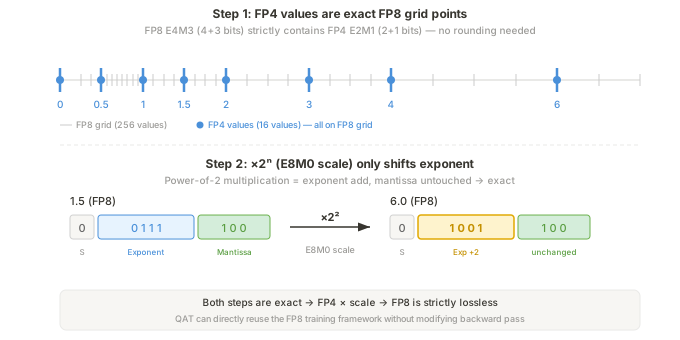
This means the entire QAT pipeline can directly reuse the existing FP8 training framework with no modifications to the backward pass. The concrete workflow:
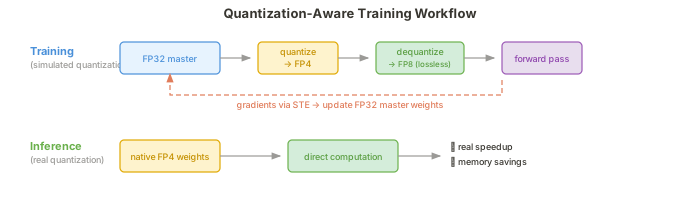
Simulated quantization during training preserves gradient signal integrity, while real FP4 during inference achieves actual hardware acceleration — model behavior stays consistent across both phases.
5. Summary
| Scenario | Recommended Format | Hardware Requirement | Quality Loss |
|---|---|---|---|
| Training (default) | BF16 | Ampere+ | None |
| Training (efficient) | FP8 / MXFP8 | Hopper+ (MXFP8 native on Blackwell) | Minimal, near-lossless |
| Training (aggressive) | FP4 | Blackwell | Requires QAT |
| Inference (near-lossless) | FP8 / MXFP8 | Hopper+ (MXFP8 native on Blackwell) | Negligible |
| Inference (memory-saving) | INT4 AWQ / GPTQ | Universal | Slight degradation |
| Inference (max throughput) | NVFP4 / MXFP4 | Blackwell | Requires QAT |
Low-precision computation is not simply about reducing bit width — it requires systematic design across format selection, scaling strategy, and module-level precision allocation. From DeepSeek-V3’s FP8 to DeepSeek-V4’s FP4+FP8 hybrid to GPT-OSS’s native MXFP4 release, this trajectory is maturing rapidly.
FP8’s 256 representable values are far from precise enough on their own — fine-grained scaling, high-precision accumulation, and other engineering techniques are what make training loss converge. The same applies to FP4: QAT, Stochastic Rounding, and module-level mixed precision are each insufficient alone, but combined they make 4-bit training work. As Blackwell’s native FP4 hardware support matures, FP4 may well become the new default for both large model training and inference within the next year or two.
References
[1] DeepSeek-AI. “DeepSeek-V3 Technical Report.” arXiv:2412.19437, 2024. https://arxiv.org/abs/2412.19437
[2] OpenAI. “Introducing GPT-OSS.” 2025. https://openai.com/index/introducing-gpt-oss/
[3] DeepSeek-AI. “DeepSeek-V4: Towards Highly Efficient Million-Token Context Intelligence.” 2026. https://huggingface.co/deepseek-ai/DeepSeek-V4-Pro/blob/main/DeepSeek_V4.pdf
[4] Micikevicius et al. “Mixed Precision Training.” ICLR 2018. https://arxiv.org/abs/1710.03740
[5] NVIDIA. “Mixed-Precision Training of Deep Neural Networks.” NVIDIA Developer Blog, 2017. https://developer.nvidia.com/blog/mixed-precision-training-deep-neural-networks/
[6] Micikevicius et al. “FP8 Formats for Deep Learning.” arXiv:2209.05433, 2022. https://arxiv.org/abs/2209.05433
[7] Frantar et al. “GPTQ: Accurate Post-Training Quantization for Generative Pre-trained Transformers.” ICLR 2023. https://arxiv.org/abs/2210.17323
[8] Lin et al. “AWQ: Activation-aware Weight Quantization for LLM Compression and Acceleration.” MLSys 2024. https://arxiv.org/abs/2306.00978
[9] Dettmers et al. “LLM.int8(): 8-bit Matrix Multiplication for Transformers at Scale.” NeurIPS 2022. https://arxiv.org/abs/2208.07339
[10] NVIDIA. “Per-Tensor and Per-Block Scaling Strategies for Effective FP8 Training.” NVIDIA Developer Blog, 2025. https://developer.nvidia.com/blog/per-tensor-and-per-block-scaling-strategies-for-effective-fp8-training/
[11] OCP. “Microscaling Formats (MX) Specification v1.0.” 2023. https://www.opencompute.org/documents/ocp-microscaling-formats-mx-v1-0-spec-final-pdf
[12] NVIDIA. “NVFP4 Trains with Precision of 16-Bit and Speed and Efficiency of 4-Bit.” NVIDIA Developer Blog, 2025. https://developer.nvidia.com/blog/nvfp4-trains-with-precision-of-16-bit-and-speed-and-efficiency-of-4-bit/
[13] NVIDIA. “Fine-Tuning GPT-OSS for Accuracy and Performance with Quantization Aware Training.” NVIDIA Developer Blog, 2025. https://developer.nvidia.com/blog/fine-tuning-gpt-oss-for-accuracy-and-performance-with-quantization-aware-training/
[14] Castro et al. “Quartet: Native FP4 Training Can Be Optimal for Large Language Models.” NeurIPS 2025. https://arxiv.org/abs/2505.14669